
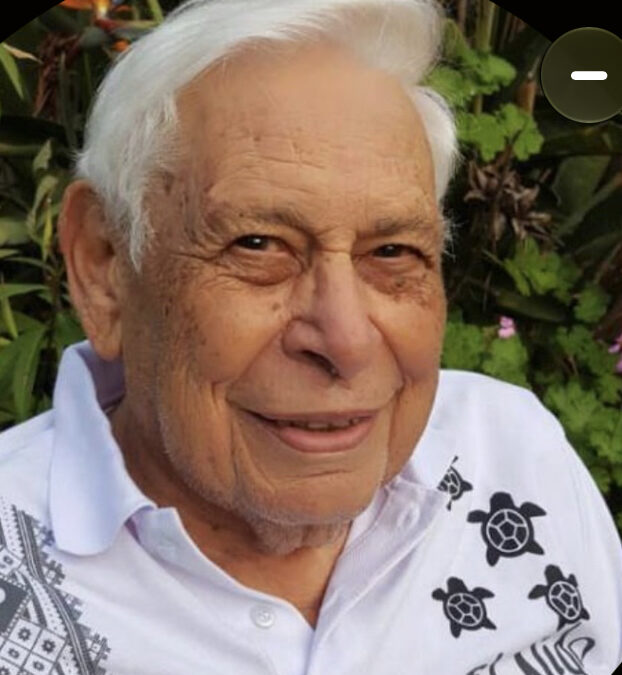
Cecil Greenfield, distinguished and respected, handwriting and questioned document examiner, passed away on 26 August 2026 as the age of 97. He was born on 19 December 1928.
I met him when I was working at a well-known Cape Town law firm in the 1990s. The firm had sent a messenger out to collect the refuse bags outside someone’s home twice a week for a few weeks and the contents were sorted so that handwriting samples could be obtained and compared with the disputed document.
I enjoyed professional dealings with Cecil. He was a marvellous witness and judges often ate out of his hands when he testfied with both authority and clarity.
A number of matters in which he testified are mentioned on his website.I hope that his family keeps this website going for posterity.
If you wish to make a donation in memory of Cecil, please click visit the Funerals & Unveilings page of the Johannesburg Chevrah Kadisha or visit its contact page for its banking details. Please mention “Cecil Greenfield” in the EFT narration. The Chev does an amazing work and it is always wonderful to hear from members of the Jewish community about it when I attend Shabbat dinners in Victory Park.
Ellison Khan, Professor Emeritus of Law and Honorary Professorial Research Fellow, University of the Witwatersrand, Johannesburg, prefaced a judgment in which Cecil was an expert witness, with this note in the SALJ many, many years ago:
The Curious Case of the Sheiks
A legal judgment that makes fascinating reading both for its extraordinary facts and for the charm of style of the author is the judgment of Mr Justice Harold L Berman in the Cape Provincial Division in the case of Sabra Shibi Shaik and Hannif Sheriff Shaik v Southern Life Association Ltd. The judgment was delivered on 26 November 1993. An application for leave to appeal was abandoned in June 1994. As the judgment will not be reported in the South African Law Reports, to save it from internment in the tombs of the archives of the Supreme Court, it will be reproduced below so far as space allows.
BERMAN J: This is the curious case of the several Sheiks, a tale in the true tradition of the classic detective story. It has a typically convoluted plot, a hero, three or four villains, perhaps even more. Counsel for plaintiffs, Mr Tobias, in opening his case, confessed that this action was indeed bizarre. He was without doubt justified in so describing the matter. . .
At first blush the case appears to be a simple and straightforward one, but that this perception is an illusion becomes apparent only too soon. It is on the face of it nothing more nor less than a straightforward claim for payment of money. The first and second plaintiffs sued as the widow and executrix in the estate of one Ismail Sheik and her son-in-law as the nominated beneficiary under a policy of life insurance issued by defendant for payment of R180 826, being the proceeds of that policy, due and payable following the death of the insured, lsmail Sheik. Defendant denied liability to plaintiff on the policy itself, alternatively on the ground of an alleged material non-disclosure as to Ismail Sheik’s state of health, and on the further alternative ground of certain fraudulent conduct on his part.
As the case proceeded, however, it became clear that this seemingly simple matter was anything but straightforward, for from the evidence the following strange and perplexing concatenation of events and circumstances came to light:
(i) one Ismail Sheik had been employed for some seventeen years by the Durban Corporation in its parks, recreation and beaches department; following a report from his superior and a medical examination by two doctors (one of whom was the senior clinical medical officer engaged by his employer), he was in January—February 1987 prematurely retired by reason of ill-health—emphysema or chronic obstructive airways disease and chronic low-back pain–on pension and on receipt of a lump-sum payment, as being incapable of even light duties;
(iii) one Ismail Sheik had, whilst the Ismail Sheik referred to above was employed by the Durban Corporation, worked from time to time for a butchery business;
(iv) one Ismail Sheik, desiring to have his life insured, underwent at the end of January 1990 a medical examination by a doctor nominated by an insurer — the defendant — and was certified as being in good health and thus a satisfactory insurance risk;
(v) one Ismail Sheik signed in January 1990 a proposal form for a life insurance policy, which was submitted to defendant, pursuant whereto the latter issued such a policy in an amount of some R80 000 with second plaintiffs as beneficiary;
(vi) one Ismail Sheik signed an application for an increase in the cover under that policy and at the end of July 1990, this application having been acceded to, the sum of R80 000 was increased on 1 August 1990 to R180 826;
(vii) one Ismail Sheik was employed by one Abdol Sheik, the manager of a swimming-pool construction company, from 10 March 1987 to 30 December 1989, and was throughout that period perfectly healthy; he was never ill, nor did he ever complain of illness, chest pains or breathing difficulties, nor did he ever give any indication of or display any symptoms of such ill-health; he was employed primarily as a driver;
(viii) one Ismail Sheik (or Shaik) testified at the trial—a person in an extremely poor state of health, sitting in a wheelchair, suffering severely from emphysema, accompanied by a large, but portable, oxygen container;
(ix) one lsmail Sheik died on 5 August 1990, apparently from natural causes.
Plaintiffs contended that the Ismail Sheik referred to in (i) to (ix) was — except for the Ismail Sheik referred to in (viii) — one and the same person and that Ismail Sheik referred to in (viii) was a different Ismail Sheik. Defendant contended that the Ismail Sheik referred to in (i) and (ii), whom the plaintiffs insist was the insured, was not the Ismail Sheik referred to in (iv), (v) and (vi) above but someone entirely different; it also says that there was more than one lsmail Sheik, that there were certainly at least two of them but that there may well have been have been three such gentlemen; if there were indeed only two, then they were certainly not the same two as plaintiffs identified. Defendant did not dispute that an lsmail Sheik died on 5 August 1990, but was adamant that whoever that Ismail Sheik was or could have been, he was not the person plaintiffs claim was the insured person, nor was he the person in respect of whom it had issued the policy in question. For all defendant could tell, and the suggestion was left hanging in the air, the former employee oft he Durban Corporation might have been alive when the claim was first advanced, and might still have been alive at the time of the trial, albeit neither hale nor hearty, being the lsmail Sheik who came to court in his wheelchair. Nor is the idea fanciful – not only did bear the same name (admittedly not an uncommon one), but they suffered from the same complaints and had at one time resided in the same house and were related to one another (though the Ismail Sheik who testified was strangely ignorant of any of the affairs and activities of his relative) and there was some confusion concerning a medical certificates which had been issued to one of them by a doctor, who was not called to testify as to which of the two Ismail Sheiks suffering from ‘wheezing’ was his patient, or if he in fact attended to only one, or perhaps two of them. The confusion was further compounded by the fact that Ismail Sheik was also known (and let himself from time to time, be known) as Sheik Ismail.
Then one of the lsmail Sheiks was 1,67 metres tall and weighed 52 kilograms in January 1987 when he was ‘boarded out’ by the Durban Corporation; another, or perhaps—if that is conceivable—the same Ismail Sheik, three years later on 11 January 1990, when medically examined by the doctor nominated by the defendant, was 1,7 metres tall and weighed 72 kilograms: Again, one of the Ismail Sheiks was incapable of even light duties; another exercised with chest-expanders and had no breathing problems. And one of the lsmail Sheiks wore dark glasses, even inside a house, although both eyes functioned; another Ismail Sheik was reputed to be blind in one eye; this further complicated matters in that it was plaintiffs’ case that the insured, who had worked for the Durban Corporation had sight in both eyes, whereas that person, according to the Corporation, was one-eyed; the employee of the Corporation, who suffered from emphysema so badly that he had to be retired, was shorter and weighed less than the person examined at the instance of defendant some years later although plaintiffs contended that they were one and the same person.
Both plaintiffs and defendant agreed that fraud was inherent in their cases, but the parties that were defrauded were in each case different. How then is all this to be sensibly accounted for? How is this mystery to be made clear? Plaintiffs offered a simple enough solution and sought thereby to explain how it was that there were two Ismail Sheiks, the one who testified in his wheelchair being one of them, and all the others being the other Ismail Sheik. Their explanation was breathtaking for its audacity. For as they cheerfully and barefacedy acknowledged, ‘their’ insured, viz. first plaintiff’s husband and second plaintiffs father-in-law, formerly in the employ of the Durban Corporation, was not above pursuing a crafty, cunning, devious and manifestly crooked course of conduct, designed and perpetrated over many months ‘with the sole intention of defrauding his employer, the Corporation, into paying him a pension before he would have rightfully been entitled to receive one and a silver (if not golden) handshake, by feigning illness and chronic ill-health whilst clandestinely carrying out arduous work on a part-time ‘moonlighting’ basis during his frequent absences from his ordinary employment on sick leave. So successfully did he disguise his malingering as a genuine disability that he completely hoodwinked his immediate supervisor and both doctors who constituted thc examining panel appointed by the Corporation to determine his state of health and to decide whether or not he should be ‘boarded-out’ of its service on the grounds of permanent physical disability.
Indeed, that ‘their’ insured had carried out a carefully crafted fraud, was a confidence trickster of the highest order and a thoroughgoing scoundrel was part and parcel of plaintiffs’ case, but they were careful to make it clear that his roguery was confined to his conduct vis-a-vis his former employer, the Durban Corporation; certainly, where defendant was concerned, his probity was unquestionable and Caesar’s wife had nothing on him.
As appears from what is set out above, plaintiffs’ case was that Ismail Sheik, who at all material times was in robust good health, was minded to take out an insurance policy on his own life, with second plaintiff; his son-in-law (or son, he being referred to in one or other document as being of the one status or the other), to be the beneficiary thereunder. To this end one A K Hassim, an insurance agent, was consulted and was called to testify on plaintiffs’ behalf. It was this witness’s evidence that he had been called in with a view to ‘selling’ a life-insurance policy to Ismail Sheik. He was introduced to Ismail Sheik by second plaintiff; and he called at Ismail Sheik’s home (or where he was then staying) and a proposal form was completed by Mr Hassim from information supplied to him by Ismail Sheik; this form was thereafter signed by him (Ismail Sheik) and witnessed (and signed) by second plaintiff. Ismail Sheik was told that a medical examination was necessary, and a few days later Ismail Sheik, accompanied by second plaintiff; attended at the consulting rooms of Dr Naidoo, where Ismail Sheik underwent a medical examination which he passed as fit and as being in good health with flying colours. Dr Naidoo signed the appropriate form which was countersigned by Ismail Sheik; second plaintiff was present throughout.
¼ Mr Hassim ¼ frankly conceded that he only knew Ismail Sheik was Ismail Sheik because that is what he was told was the name of the person to be insured and who put that name to his signature on the proposal form and medical examination form—he had never in fact seen or heard of this man (or of second plaintiff) before; for all he knew, in retrospect, this person who wanted life insurance could have been an Indian person with any name.
From his general, if inexpert, view of Ismail Sheik, he appeared to weigh approximately 70 kilograms, which Ismail Sheik told him was his true weight, and when Mr Hassim measured him for height, he was satisfied that Ismail Sheik was some 1,70 metres tall.
[His lordship then pointed out that, at the request of the second plaintiff; Mr Hassim arranged for additional life-insurance cover of R100,000 without further medical examination. On 5 August 1990, four days after the additional cover had become effective, Ismail Sheik died.]
Plaintiffs’ second witness was one Abdol Sheik, the contracting manager of a business known as Ocean Pools cc. This witness testified that Ismail Sheik was employed by that business from 10 March 1987 to 30 December 1989, and that he saw Ismail Sheik every working day. Ismail Sheik, whom he—as did Mr Hassim—identified from the photograph in his so-called ID) book, was apparently fit and healthy and his work gave no cause for complaint; indeed, he did not miss a day’s work through illness . . . . [T]here is no reason why his testimony as to the nature of Ismail Sheik’s employment and his work record should not be accepted. What is significant is that he had not previously known his former employee, and he could well have been an Indian man with a different name who said his name was Ismail Sheik.
Nor had Dr Naidoo, who examined Ismail Sheik at the instance of Mr Hassim for the purpose of completing the medical form required by had defendant, ever seen or heard of Ismail Sheik before this gentleman attended at this doctor’s consulting room. He identified himself to Dr Naidoo as Ismail Sheik, and the doctor accepted him as so identified. Dr Naidoo, as his medical report made clear, found Ismail Sheik to be in good health; his weight was 72 kilograms and his height was 1,70 metres. He stated that chronic obstructive airways disease is incurable, and that it was clearly, indeed extremely, unlikely that a sufferer from that disease could have gained height and increased his weight by some 20 kilograms over a period of three years; chronic obstructive airways disease was a wasting illness.
So far, as it is frequently said, so good. From here on, with the appearance of second plaintiff in the witness box, the case commenced to take an unusual course. Second plaintiff, as Mr Hassim had observed, had ‘played quite an active role in this insurance policy’. He was the key witness in plaintiffs’ case; he was the son-in-law of Ismail Sheik, and was and regarded by him as his son; he was the second plaintiff; he was the sole beneficiary in terms of the policy; he was—in association with the insured—the architect of a fraud, either committed on the Durban Corporation or attempted on defendant, and he helped to orchestrate it; he was also at times either too voluble or too reluctant to say much; he was also a liar, who lacked even a nodding acquaintance with the truth. He left on the court a most unsatisfactory impression as a witness—his demeanor was shifty and furtive and his creditworthiness minimal.
The tale he spun was a web of admitted deceit. It seems that his father-in-law, unhappy with the treatment meted out to him during the twelve months prior to leaving his employment with the Durban Corporation at the hands of the supervisor who had taken over that post at the commencement of that period, had decided to ensure the receipt for himself of a pension and accompanying handshake by being (or by having himself declared medically unfit. To leave his job otherwise would have meant forfeiting these benefits. He therefore embarked on an acting career, feigning breathing difficulties (which did not in reality occasion him), necessitating frequent absences from work by way of sick leave. He did not spend these periods of enforced idleness by recovering his strength, but passed ‘each shining hour’ by ‘moonlighting’ for a butchery business, a practice he followed clandestinely and dishonestly for something like a year, that is, ever since the new (and unpleasant) supervisor Mr Lang had been appointed to that position . . . .
He [second plaintiff] described how, when and where his father-in-law had died, and how he obtained the services of Dr Ramkissoon, who had previously been the family doctor, to provide the necessary death certificate. He was obliged to concede that it was some eight or nine years previously that this ‘family doctor’ had last had Ismail Sheik as a patient, and second plaintiff did not know whether or not Dr Ramkissoon could in fact have recognized his former patient. In all probability this doctor had no occasion, when providing the death certificate, to doubt that the body pointed out to him as being that of one Ismail Sheik was indeed that person’s body.
It became evident as second plaintiff’s testimony proceeded that there were considerable negotiations after his father-in-law died between him and an ever-increasingly suspicious defendant; graver and graver doubts were being created in the minds of defendant’s personnel investigating second plaintiff’s claim; on two separate occasions and by two separate persons the suggestion was advanced to him that there was ‘a dummy in the graveyard’.
[His lordship then analysed certain letters written by the second respondent, and having reached certain conclusions, summed up as follows:]
These letters are in response to a request from defendant seeking further information, which letter was dated 07/01/1991. The handwritten letter and the typed version set out the working life history of second plaintiff’s father-in-law in considerable detail and this information could only have been provided by someone who knew that person intimately. Yet despite the enquiry being addressed to second plaintiff and notwithstanding that the reply apparently bears his signature, he denied ever having received the enquiry or authored the response—nor could he account for who might have taken the letter addressed to him or replied in his name.
What is most surprisingly lacking from the work record set out at length in the letter dated 10-1-91 (as copied in that dated 12-1-91) is any reference to the almost seventeen years of service second plaintiff’s father-in-law rendered to the Durban Corporation for that period which ran from 1970 to 1987 is largely covered in the letters of 10 and 12 January by a number of years of employment, between 1977 to post-1987, with the Umla Butchery, where-according to second plaintiff in his evidence—-his father-in-law had ‘moonlighted’ during periods when he took ‘sick leave’ during the last year or years of his employment with the Corporation . . . . All this damns second plaintiff as the liar I found him to be.
Second plaintiff’s evidence under cross-examination touching upon the so-called ‘second Ismail Sheik’, who was yet to testify. Simply beggars belief. This gentleman did indeed suffer from chest pains and low back pains, and it was second plaintiff who supplied him with oxygen and paid all his medical accounts from 1985 onwards. This person was, so second plaintiff said, his uncle. Second plaintiff embarked on a convoluted story as to a medical certificate this sickly uncle had obtained on 16 January 1987 from Dr Naiker relating to his inability to work as a consequence of his chronic obstructive airways disease and low back pain and recommending early retirement; as to how a copy or copies of this certificate was or were made; and as to how the original certificate went missing from his uncle’s possession, possibly having been stolen from him. Second plaintiff had no idea at all who the possible thief could possibly have been. The proposed fraud was never discussed with the sickly uncle, though for some years he, second plaintiff and second plaintiff’s father-in-law all lived together in the same house (or did so from time to time) between 1987 and 1990. It is enough to say that second plaintiff left the witness box a thoroughly discredited witness.
The so-called ‘second Ismail Sheik’ gave his evidence sitting in a wheelchair. He was quite clearly an extremely ill man who breathed with great effort and difficulty. He identified himself as Ismail Sheik and acknowledged that the photograph in one of the ID books was his and that a second photograph in another ID book was that of his nephew’s father-in-law. He said that he suffered from chronic airways disease, back pain and epilepsy. He identified Dr Naiker’s certificate as having been given to him, but that the last time he had seen it was when the other Ismail Sheik had been reading it on the day he (the witness) came home with it. Fortunately he had made copies of it. He knew that other Ismail Sheik as a strong man, who regularly made use of bodybuilding equipment to ‘make himself a stronger person . . . he had never noticed him ill’.
Under cross-examination he said that he and his nephew’s father-in-law, whilst both lived tinder the same roof, had little communication with each other. The witness knew that his namesake had worked for the Durban Corporation, but he was not aware that his employment there had come to an end. He had no idea that the latter had ever pretended to be sick and his nephew had never discussed this pretence with him nor did he assist in any way with the perpetration of a fraud on the Corporation. He was unable to admit or deny that ‘the other Ismail Sheik’ was blind in one eye. He was furthermore at a total loss for an explanation as to how a certificate dated 16 January 1987 was made out and signed by Dr Naiker (his doctor) to the effect that Ismail Sheik, an employee of the Durban Corporation, suffered from ‘wheezing’ and recommending that he be granted a day’s sick leave, when Dr Naiker knew very well that the witness was not, and had not been, employed by the Corporation, but by a picture-framing firm. He denied ever telling Dr Naiker that he worked for the Corporation and how the certificate came to reflect that he did was, as far as he was concerned, totally inexplicable. Indeed, on the same day as this certificate, completed on a form provided by the Corporation, was issued, Dr Naiker issued a separate certificate (to which reference has already been made) recording that Mr lsmail Sheik suffered from chronic obstructive airways disease and chronic low-back pain and that he would probably require medical attention for the rest of his life; ‘it would be best’, Dr Naiker wrote, ‘to retire him early.’
With that plaintiffs’ case was closed. Defendant’s counsel, Mr Fitzgerald, called as its first witness Mr Lang, a horticulturist and the supervisor during the last year of employment of Ismail Sheik as a ‘flower planter’, as second plaintiff had told the court his father-in-law had described what work he did. He said he knew the employee Ismail Sheik as a labourer in his department and he identified him by his photograph as shown to him in his ID book. He said that he had learnt from his predecessor that this employee had breathing problems, and his own experience confirmed this. As he was continually receiving complaints from Ismail Sheik, notwithstanding that he put him on relatively light duty, he eventually sent a note to his immediate superior suggesting that Ismail Sheik have ‘a medical check-up’, to which note he attached the certificate provided by Dr Naiker (which certificate, it will be recalled, had been given by that doctor to the other Ismail Sheik). As a result Ismail Sheik went to the Corporation’s Health Department for a medical examination; the witness was unable to say with any certainty whether he accompanied Ismail Sheik to the Health Department, but the probability was, he said, that he may well have done so. He could not verify that Ismail Sheik was blind in one eye . . ., but he confirmed as a fact that he wore ‘darkish’ glasses. It was furthermore his impression that, when it was said that Ismail Sheik was a fit man and a body-builder, ‘I think we are talking . . . [about] . . . two different people’.
Dr Dees testified that in 1987 the Durban Corporation employed him as assistant medical officer of health. He identified a document with the letterhead of that Corporation headed ‘Medical Examination’ and bearing his signature. This medical report on the Corporation’s employee, Ishmail (sic) Sheik, reads as follows—
‘This man was seen in the Medical Bureau on 27 January 1987.
‘He finds he cannot manage his work on account of considerable shortness of breath.
His supervisor who accompanied him confirmed this.
‘On examination he has signs of marked emphysema. He was abnormally short of breath while being examined and the test of lung function was very poor.
‘His doctor states that his condition has not improved with treatment and suggest that he be medically boarded.
‘The Board is of the opinion that this man should he retired for medical reasons. His condition is very unlikely to be improved with further treatment.’
On the same day the accompanying personal statistical report recorded that Ishmail (sic) Sheik was blind in his right eye, that his height was l67 cms and that his weight was 52,5 kgs.
I interpolate at this stage to point out that it was thus plaintiffs’ contention that this Ismail Sheik, who was the subject of this medical report and who was ‘boarded out’ of the Corporation’s employment by reason of ill health, was the same Ismail Sheik who—as plaintiffs would have the court believe—for almost three years thereafter worked for Ocean Pools cc without absenting himself from work for a single day, who ‘worked out’ with a chest-expander and who, most extraordinarily, in the three years between this medical examination and that conducted by Dr Naidoo, actually grew three centimetres in height and gained over 40 pounds in weight, notwithstanding that he suffered from a wasting and debilitating disease.
Dr Dees described the procedure followed for such medical examinations. In the particular case of lsmail Sheik he had been examined, as recorded above, by Dr Edington, on 27 January 1987, then the senior medical officer of health, who had since died. [T]he case was a straightforward one and all that was called for was a discussion between him and Dr Edington after the examination was completed, in which he confirmed Dr Edington’s findings. The witness said that he found it unlikely that a person such as was the subject of Dr Edington’s findings and Dr Naiker’s certificate could have worked for almost three years performing physical duties—the one situation was inconsistent with the other.
Dr Barker is defendant’s ‘medical officer of health’ in Cape Town. He testified that in his opinion both emphysema and obstructive airways disease are incurable and that had it been disclosed to defendant the proposal for life insurance would have been declined.
At this stage it was indeed a murky picture that had been presented to the court. It featured two ID books of persons having the same name, viz. Ismail Sheik, living in the same house; two medical reports or certificates relating to one or other of them, reflecting one of them as in good health and the other in poor health; two doctors, Naiker and Ramkissoon, who could have assisted the court in identifying which Ismail Sheik was which, but who were not called by plaintiffs, although notice that Dr Naiker ought be called as a witness was given, whereas neither Dr Naidoo nor Dr Dees knew or had seen any lsmail Sheik previously; there was a suggestion that no Ismail Sheik had been buried, but that there was a dummy in the graveyard; there was some question as to whether the difference in height and the marked difference in weight between the two Ismail Sheiks related to one of them or to two different ones; there was the strange loss and stranger reappearance of Dr Naiker’s certificate; there was the identification of the Ismail Sheik who always wore dark glasses but who was said to have had sight in both eyes, with the Ismail Sheik who had but one eye; there was the urgency in the request for maximum additional cover without the need for any further medical examination; there was the death of Ismail Sheik only four days after the insurer had more than doubled the value of the policy; there were the letters bearing the signature of second plaintiff which he said were forgeries; there was
the possible, but extraordinary, coincidence of two men, bearing the same name, living in the same house and both suffering from the same wasting and incurable disease. And these instances, which have been described as ‘murky’, must certainly not be taken to be exhaustive of the murkiness of the scenario that the court found itself facing.
All this raised questions that beset and bedeviled the court. How many Ismail Sheiks were there? Was there really an unqualified horticulturist who suffered from chronic obstructive airways disease and chronic back pain and was there another person with the same name with the identical complaint and both living under one roof? Or was the former as a fact fit and healthy and so consummate an actor in the direct line from David Garrick to Laurence Olivier that he could successfully ‘con’ Mr Laing, Doctors Edington and Dees (and perhaps also Dr Naiker) into finding that he suffered from chronic obstructive airways disease and chronic back pain to such a degree that it called for his premature retirement, when all the time during which he was engaged in this play-acting, he was both hale and hearty? Who was the man with one eye and did he wear dark glasses? Was there a theft by the Corporation’s employee of his namesake’s medical certificate and a fraudulent use thereof? Could Ismail Sheik, chronically sick as he was, have gained almost twenty kilograms in weight in three years or grown taller in that period of time without procrustean aid? Which Ismail Sheik died? Indeed, did any one of them pass away? And finally, and surely it is not too far-fetched and fanciful a thought—was (and is) second plaintiff’s father-in-law, allegedly insured and allegedly dead and buried, still in fact alive and confined to a wheelchair?
And so the plot thickened. What the devil, one may well say, had been going on? With each succeeding witness the matter was becoming more and more of what the King of Siam once called ‘a puzzlement’. The case, to quote from Alice in Wonderland, was becoming ‘curiouser and curiouser’, when on to this baffling and bewildering scene there came to the rescue of the bemused reader (and judge) the witness Mr Greenfield. If there is a hero to this story (as I believe there is) then it is he, for he performed in these proceedings the function reserved for the detective hero in that particular genre of light reading, for he proceeded in the witness box to solve the mysterious case of the several Sheiks, to the ultimate satisfaction of the court. Unlike the traditional detective story, however, where all the loose ends are neatly tied together and the red herrings have been identified and disposed of in the final pages of the last chapter, some questions remained hanging in the air unanswered in the end, for here we are dealing in real life, fantasy though it may appear to be; but the key to the riddle which makes it possible to give judgment with a considerable measure of confidence in this case in so far as the parties are concerned was provided by Mr Greenfield.
Mr Greenfield, it is true, did not display any of the idiosyncrasies and eccentricities of famous fictional detectives. He was a straightforward, quietly spoken, no-nonsense witness, whose expertise lay (and lies) in the field of analysis and identification of handwriting. He listed in the witness box a formidable catalogue of qualifications and he spoke with the authority which comes with thirty-five years of experience in his particular field; he was a compelling and impressive witness, readily conceding under cross-examination that which had to be conceded, yet firmly confident in confirming his findings concerning the various signatures examined by him. He was at no stage dogmatic in advancing his opinion; he readily conceded that the interpretation of handwriting is not an exact science; there is always room for error; advancing age and the circumstances under which a signature is appended can certainly cause variations therein. The fact remains, however, that when he eventually stood down, after re-examination, the case—to all intents and purposes—was over.
What Mr Greenfield had done, and what he proceeded to demonstrate to the court whilst in the witness box, was as follows: he had been provided with, and had examined, a number of signatures of Ismail Sheik (or Sheik Ismail); two of them are on a document dated 29 January 1989 (the completed application for life insurance, the ‘proposal’); there are two of them on a document dated two days later, viz. 31 January 1989 (the completed medical report from Dr Naidoo); there is one on a document dated 30 Ju1y 1990 (the application for the increased cover); and there is one on an undated letter bearing defendant’s date-stamp marks (7 and 10 September 1990, which must–if not a forgery–have been penned prior to 5 August 1990). Mr Greenfield was of the opinion that even though there was a time gap of some six months between the first four signatures and that of 30 July 1990, and notwithstanding that passage of time, these various signatures were not those of the same person. In his opinion there were certainly two different signatories; there were, he said, possibly even three. What is of particular significance is the fact that the signatures on the proposal and those on the medical report were, in Mr Greenfield’s opinion, appended to those documents by two different persons!
Now Mr Greenfield did not know, when he examined and compared these various signatures, which one, if any, was that of the Ismail Sheik who had been employed by the Durban Corporation. During the course of the trial, however, he was handed three further documents, viz. the Employee’s Record Form bearing the signatures of Sheik Ismail twice and each bearing the date stamps of 16 February 1987 and 27 February 1987; a Certificate of Service Form bearing the signature of Sheik Ismail, dated 24 February 1987; and an undated Personal Details of Members Form completed for pension-fund purposes and bearing the signature of Sheik Ismail. All four of these signatures were, in Mr Greenfield’s opinion, those of the same person.
Now the signatures on the Employee’s Record Form were positively identified by second plaintiff as that of his father-in-law, that is, the former employee of the Durban Corporation and the person whose life had been insured by defendant and in respect of whom second plaintiff (and his mother-in-law, first plaintiff) claimed payment. It was, however, Mr Greenfield’s firm and reasoned opinion that notwithstanding the passage of some three years between the completion and signatures on the three documents now examined by him and those previously examined by him, and the transposition of the names ‘Ismail’ and ‘Sheik’ in the various signatures, and other affecting signatures . . . the signature on the Employee’s Record Form was not that of the person who signed the application for insurance (or the person who signed the name Ismail Sheik on the proposal form); the signatory to the application for insurance was not the same person who had signed the Employee’s Record Form.
Mr Greenfield remained unshaken by Mr Tobias’s searching cross-examination and I fully accept this witness’s views as being correct…
It was contended by plaintiffs, and it indeed was their case, that a valid, binding and enforceable contract of insurance had been concluded between the former employee of the Durban Corporation and defendant. It is clear, however, from Mr Greenfield’s evidence, that that person did not sign the proposal form, that is, he did not make an offer to defendant by way of the submission of a duly signed and completed proposal form, nor was it ever suggested that the signature Ismail Sheik was that of a person authorised to sign by way of power of attorney. The offer was thus made by a person other than the prematurely retired employee of the Durban Corporation and whose alleged death gave rise, according to plaintiffs, to their claim. In the most simple of terms, no contract of insurance was ever concluded between the said ex-employee and defendant, and consequently no legally enforceable claim can be advanced thereunder by plaintiffs.
Whether second plaintiff’s father-in-law, the former employee of the Durban Corporation who plaintiffs claim was the insured, was dead and buried may perhaps be questionable; it seems to me beyond doubt, however, that that person did not sign the proposal form. Furthermore, whether any contract of insurance was concluded between the signatory to the proposal and defendant is no concern of mine—suffice it to say that no such contract was concluded between second plaintiff’s father-in-law and defendant.
There remain, as I have already noted, a number of loose ends and questions which are left untied and unanswered. But as I have also earlier observed, this is real life and not after all a detective novel. For instance, there remain, among others, the questions as to who did sign the proposal and who did sign the medical report; what was the role played by the man in the wheelchair; who, if any one, was the man with one eye; and was there a dummy in the graveyard? These are all open to guesswork, conjecture and speculation, and the answers can only be provided by the two plaintiffs and the man in the wheelchair; it is certainly unnecessary for me to suggest solutions to riddles. What I can do is this—having identified the hero, I am able to identify the villains, they being certainly the two plaintiffs (for the widow could not conceivably have been unaware of what was going on around her), the signatory to the proposal and, possibly, indeed more than possibly, the Ismail Sheik in the wheelchair . . . .
. . . . I am satisfied that plaintiffs’ claim must fail on the ground set out at length herein and that judgment should be entered in favour of defendant with costs, such costs to include the qualifying expenses of Mr Greenfield; in addition he, Mr Lang, Dr Dees and Dr Barker are declared necessary witnesses.
It is accordingly so ordered.
Note by the editor: On 5 August 1995, after this number of Journal had gone to press, Mr Justice Harold Berman died of a heart attack. I would like to convey my condolences to Mrs Berman and the other members of the late judge’s family.